







How Accurate Are Personal Weather Station Forecasts?
by Doug Analla
by Doug Analla
Personal weather stations (PWS) can deliver remarkably accurate hyperlocal forecasts when they are well sited, maintained, and paired with quality software. Because they measure conditions at your exact location, they often outperform broad regional forecasts for your yard, farm, marina, or job site. If you have asked yourself how accurate are personal weather station forecasts, this guide outlines how these forecasts are generated, what influences accuracy, how far ahead you can rely on them, and how to get the best results from your station. We also touch on how accurate is weather a week out and what to expect from a how accurate 10 day forecast so you can plan with confidence.
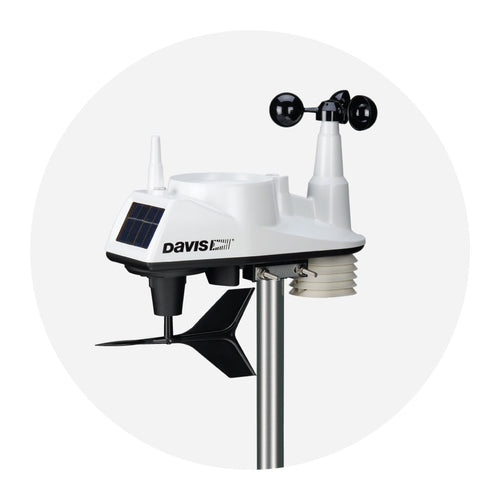
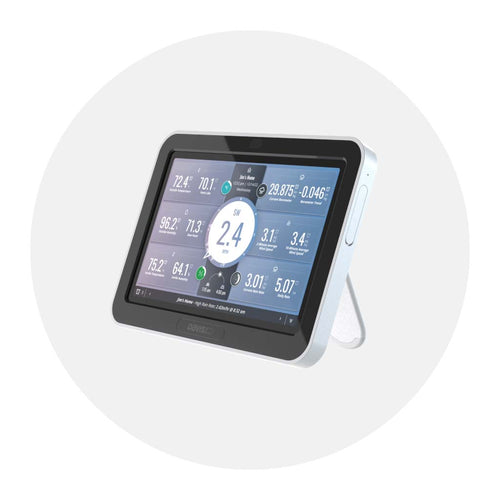
Davis Instruments has led the personal and professional weather market for decades, delivering dependable hardware, software, and support. Our Vantage Vue, Vantage Pro2, and EnviroMonitor product families, apps, and data services help thousands of users answer the question, how accurate are personal weather station forecasts, with reliable, repeatable results.
A PWS tracks the core variables that drive weather changes: temperature, humidity, barometric pressure, wind speed and direction, and rainfall. These inputs feed algorithms that detect patterns, such as falling pressure ahead of a front or rapidly rising humidity before fog or precipitation. Stations also compute derived values like dew point, wind chill, heat index, and rates of change that sharpen short-term predictions.
Personal weather stations typically support three complementary forecasting approaches:
Sensor placement, calibration, and update frequency are critical. Place temperature and humidity sensors in a ventilated radiation shield, mount anemometers with clear exposure, and keep rain gauges level and unobstructed. Calibrated sensors and frequent updates—often every 1–10 seconds for wind and every 1–5 minutes for other variables—give algorithms fresh, high-quality inputs that detect changes early and produce stable, trustworthy local forecasts. This foundation is essential when you want to judge how accurate are personal weather station forecasts compared to an app’s 10 day forecast.
Environmental siting and installation choices strongly influence forecast skill. Poor placement near roofs, concrete, or dark fencing can heat-bias temperature readings; nearby walls or trees can block wind and distort rainfall. Elevation mismatches for pressure sensors and insufficient shielding introduce noise and bias. Vegetation can dampen wind and create shade-driven temperature swings that differ from open terrain.
Instrument quality and care matter. Higher-grade sensors with effective shielding, routine cleaning, and periodic calibration hold accuracy across seasons. Well-designed firmware and software apply corrections for solar heating, wet-bulb effects, and tipping-bucket rain intensity biases, and filter outliers without over-smoothing genuine changes. Neglected instruments collect debris, spider webs, and bird droppings that degrade observations and forecasts.
Data characteristics also affect outcomes. Higher sample rates and uninterrupted data streams help identify fast-moving boundaries and wind shifts. Gaps, latency, or infrequent uploads reduce skill. Complex microclimates—coastlines, hills, and urban canyons—create sharp gradients over short distances; forecasts that incorporate regional model guidance generally perform better in these settings. Integrating your PWS with trusted mesoscale models and quality-controlled networks adds context for larger-scale systems your station cannot sense alone. These practices directly influence the accuracy of personal weather station forecasts across time horizons.
Forecast confidence varies with time horizon. Nowcasts spanning the next minutes to a few hours are where personal stations excel, especially for wind shifts, temperature jumps, developing sea breezes, and imminent showers. Short-term forecasts out to 24–48 hours are typically reliable when local observations are blended with regional models. Beyond two days, forecast skill depends mainly on the underlying NWP rather than the station alone. If you are wondering how accurate is weather a week out, expectations should be modest: skill becomes more variable, and uncertainty grows with each day. A how accurate 10 day forecast is largely driven by larger-scale models and should be viewed probabilistically rather than as a deterministic outlook.
Spatially, a PWS provides excellent guidance within its immediate microclimate—often tens to a few hundred meters—such as a backyard, field, or marina slip. As you move into different terrain, elevations, or land cover, conditions can diverge quickly. For town- or county-wide predictions, regional models and radar-based products are more appropriate, with your station supplying local adjustments for timing and intensity.
Typical errors include underestimating rapid temperature swings during frontal passages, mistiming precipitation onset by an hour or two, and missing localized downpours or convective bursts that form between model grid points. Wind shifts can arrive earlier or later than expected if terrain channels the flow. Interpreting confidence helps: watch rate-of-change indicators (pressure fall rate, dew point rise), probabilistic precipitation, and agreement between model guidance and your live observations. If your station’s data diverge from the forecast—such as pressure leveling off instead of falling—treat the forecast with caution and expect updates. This approach is especially useful when you evaluate how accurate 10 day forecast guidance is for your specific microclimate and when asking how accurate is weather a week out for planning purposes.
Start with optimal siting and mounting:
Perform routine maintenance and calibration checks. Clean radiation shields, remove spider webs from wind vanes, verify rain gauge tips with a measured volume, and compare pressure against a nearby reference adjusted to your elevation. Keep firmware updated to benefit from improved algorithms, sensor corrections, and security fixes that enhance forecast stability and accuracy.
Use your data alongside regional forecasts and radar. Set alerts for pressure drops, wind gust thresholds, heat index, and rainfall rates. Learn your microclimate’s patterns—afternoon upslope breezes, urban heat island effects, marine layers—and monitor rate-of-change graphs for early signals. Confidence tools like probabilistic precipitation and model spread help you choose an appropriate plan for outdoor work, agriculture, or events. These habits will help you determine how accurate are personal weather station forecasts today, tomorrow, and when assessing how accurate is weather a week out. With careful siting, consistent maintenance, smart data use, and ongoing support from Davis Instruments, a personal weather station can deliver accurate, actionable local forecasts you can trust, while helping you set realistic expectations for any how accurate 10 day forecast you see in your favourite weather app.